What happens on the pitch when SCOPER turns red?
We examined 58,590 live minutes from 651 matches across 20 leagues in October 2026. As the SCOPER tier rises, the rate of goals and big chances in the following minutes climbs steadily — and the moments a match enters the critical tier are clearly more productive for goals than an average minute.
What is SCOPER?
SCOPER is Goalscope's live intensity measure for matches in progress, updated every minute. It condenses how "hot" a match is right now into a single value and places the match in one of five tiers: neutral, low, medium, high and critical. In the app, colours show these tiers, and simultaneous matches are ranked by this value.
SCOPER is not meant to predict goals; its job is to help the user find the matches where something is happening right now, among hundreds of live games, in seconds. The question of this report was built around that: when a match enters the high or critical tier, do goals or big chances really follow in the next 10–15 minutes?
Data and sample
The study covers 20 leagues, including Turkey's Süper Lig (the full list is in the FQ report). Of the 766 league matches completed in regular time between 1 and 31 October 2026, 651 were analysed: matches with complete live SCOPER measurement for the full game, goal events that matched the score exactly and a consistent big-chance count. Only values actually calculated live, in that minute, during the match were used; no series recalculated afterwards entered the sample.
Two things were counted as an "event": a goal (including penalties and own goals) and a big chance. Over the month, the sample recorded 1,989 goals and 3,095 big chances. 68% of matches reached the high tier at least once, and 37% reached the critical tier at least once.
Findings
1. Higher tier, more action
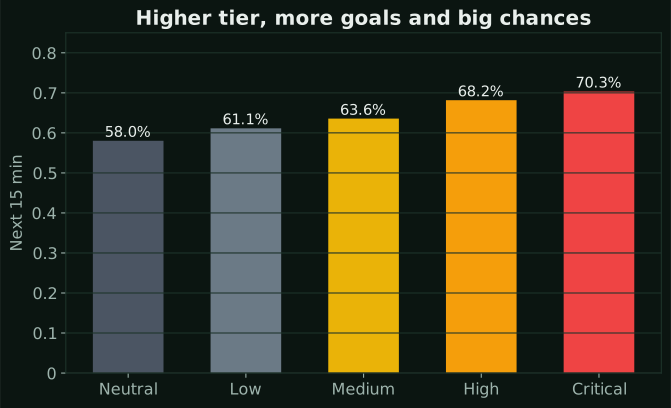
A goal or big chance followed within 15 minutes for 58.0% of minutes in the neutral tier. The rate rises to 61.1% in low, 63.6% in medium, 68.2% in high and 70.3% in critical. Looking at goals alone, the ladder is the same: from 38.4% to 47.5%.
| Tier | Minutes | 10 min event | 15 min event | 15 min goal |
|---|---|---|---|---|
| Neutral | 18,035 | 43.2% | 58.0% | 38.4% |
| Low | 19,066 | 47.1% | 61.1% | 38.8% |
| Medium | 6,751 | 49.9% | 63.6% | 41.9% |
| ● High | 3,456 | 54.2% | 68.2% | 44.9% |
| ● Critical | 1,429 | 56.0% | 70.3% | 47.5% |
Event: a goal or big chance within the next 10 or 15 minutes. Goal: goals only.
Whether this increase across tiers could be due to chance was tested with the Cochran–Armitage trend test, used for ordered proportions: z = 14.5, meaning the trend is extremely strong statistically.
2. Entering critical: the most productive moment for goals
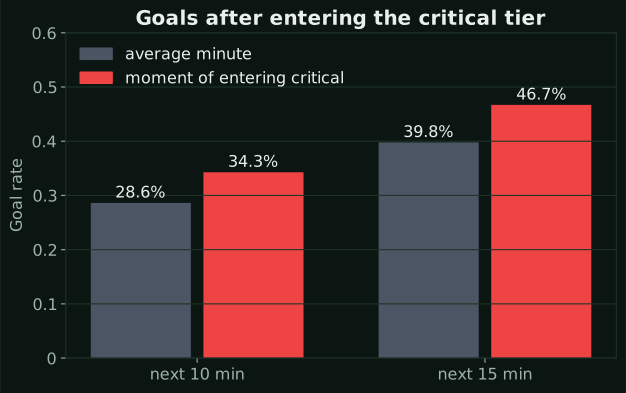
We looked separately at the 391 moments when a match had just entered the critical tier. In the following 10 minutes a goal came 34.3% of the time, and within 15 minutes 46.7%. Averaged over all live minutes in the sample, those rates are 28.6% and 39.8%. In other words, the 15 minutes after entering critical are about 17% more productive for goals than an average minute.
To test whether this difference is real in the strictest way, we used a within-match permutation test: in each match, we drew as many random minutes from that same match as there were critical entries, and recalculated thousands of times. This removes the "matches with lots of goals simply become critical" effect entirely. Result: p = 0.005 (15 min) and p = 0.001 (10 min). The goal value of the moment of entering critical is significant independently of the match itself.
Counting goals and big chances together, one of the two followed within 15 minutes of entering critical 69.2% of the time, and 67.0% after entering high (95% CI 63.2% – 70.6%).
3. Action usually comes quickly
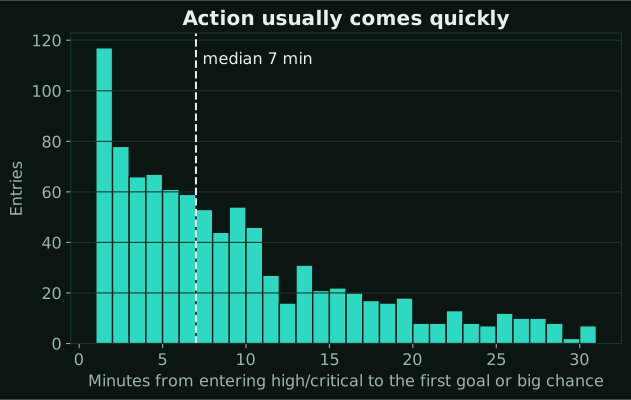
The median time from entering the high or critical tier to the first goal or big chance is 7 minutes; for half of all entries, the first event arrived between 3 and 15 minutes later. SCOPER's signal leaves the user enough time to open the match and start watching, without long waits.
4. Ranking simultaneous matches correctly
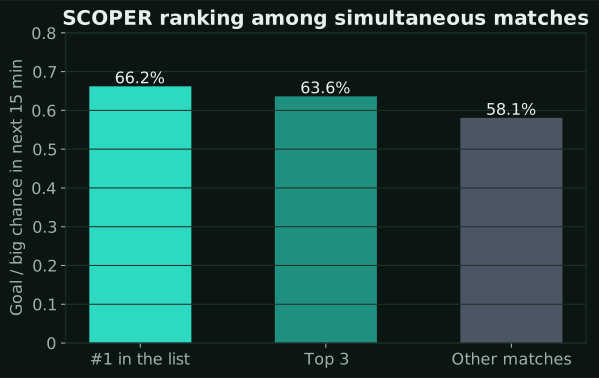
Goalscope's home screen ranks the matches in progress by SCOPER. To see whether this ranking works, we examined, one by one, the 5,974 moments in the month when at least three matches were being played at once (6.1 simultaneous matches on average). For the match at the top of the list, a goal or big chance followed within 15 minutes 66.2% of the time; for the top three, 63.6%; for the rest, 58.1%. For goals alone: 43.3% at the top, 40.9% in the top three, 37.1% for the others.
A user who glances at the top of the list as soon as they open the screen is, on average, pointed towards a livelier match.
5. Critical matches are livelier matches
At whole-match level the picture is consistent: matches that reached the critical tier at least once saw an average of 9.3 goals and big chances; matches that never reached it saw 6.9. The rank correlation between a match's average SCOPER level and its total goals and big chances is ρ = 0.49.
6. League by league
Compared with the average minute in the same league, the 15 minutes after entering the high tier were more productive in 15 of the 20 leagues. The clearest differences were in the J1 League, the Russian Premier League, the Belgian Pro League, the Championship and La Liga. With between 12 and 93 entries per league, single-league results can change from month to month; the overall assessment should rest on the combined 20-league results.
Method
- Unit
- Live minute (58,590 minutes). Only minutes whose following 10- or 15-minute window did not go past the 90th minute were used; events in stoppage time were recorded at the 90th minute.
- Success definition
- A goal or big chance within 10 or 15 minutes after a match enters the high or critical tier. A separate goals-only definition is also reported.
- Tier trend
- Rates by tier and the Cochran–Armitage trend test.
- Entry moments
- The minute in which a match moved into a tier it was not in the previous minute. Confidence intervals use a match-clustered bootstrap (1,500 resamples); significance uses a permutation test drawing random minutes from within the same match (1,000 repetitions).
- Simultaneous ranking
- Matches live in the same UTC minute (at least three) were ranked by SCOPER and event rates compared across rank groups; the confidence interval of the ranking effect uses a match-clustered bootstrap.
- Additional models
- Match-clustered logistic regression (GEE), conditional logistic regression with match fixed effects, a Cox model for recurrent events (Andersen–Gill), and between-match Spearman correlation with the Mann–Whitney test; findings were assessed together with these models.
Limitations
Goals and big chances are frequent in every phase of football, so the edge SCOPER provides is relative rather than absolute, and nothing may happen in any single match. Although the tier ladder and critical-entry findings are strong, the goal-or-big-chance yield of high-tier entries does not always show a significant difference in within-match comparisons; SCOPER gives its strongest signal in the critical tier and for goals. This report is based on one month of data, and the results describe association and make no causal claim.